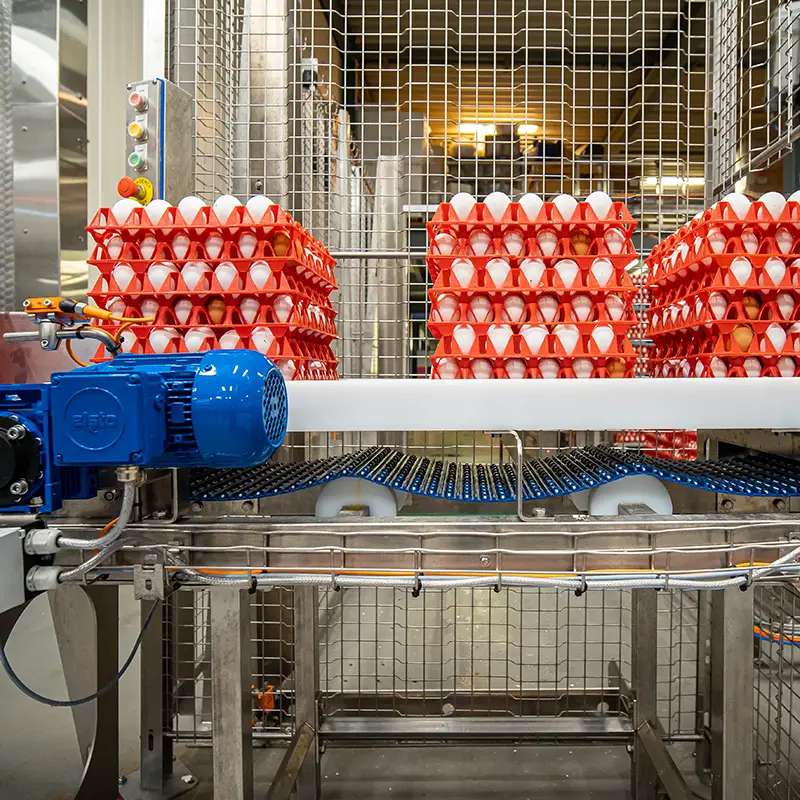

How camera inspection prevents errors in egg processing
Preventing errors in egg processing is essential for food safety, efficiency, and your company’s reputation. Camera inspection, particularly advanced vision systems, is key to achieving these error-free processes. In practice, we see these technologies revolutionizing the sector by consistently and accurately detecting defects invisible to the human eye, significantly improving product quality and reducing operational costs. At EN | Elsto Smart Solutions, we have been developing smart solutions for years, specifically addressing the unique challenges of egg processing, with a focus on precision and reliability.
What kind of information do you find in this article:
What are the most common errors in egg processing?
The most common errors in egg processing range from minor visual defects to critical quality deviations that compromise food safety. These include broken or cracked eggs, dirt or blood stains on the shell, abnormal shapes or sizes, and internal defects such as blood spots or double yolks that are not visible through the shell. Traditional manual inspection is labor-intensive, inconsistent, and prone to human error, especially at high production speeds. Our experience shows that human inspectors inevitably become less accurate during long shifts and with large volumes, leading to a higher rejection rate later in the process or, worse, to the delivery of products that do not meet quality standards.
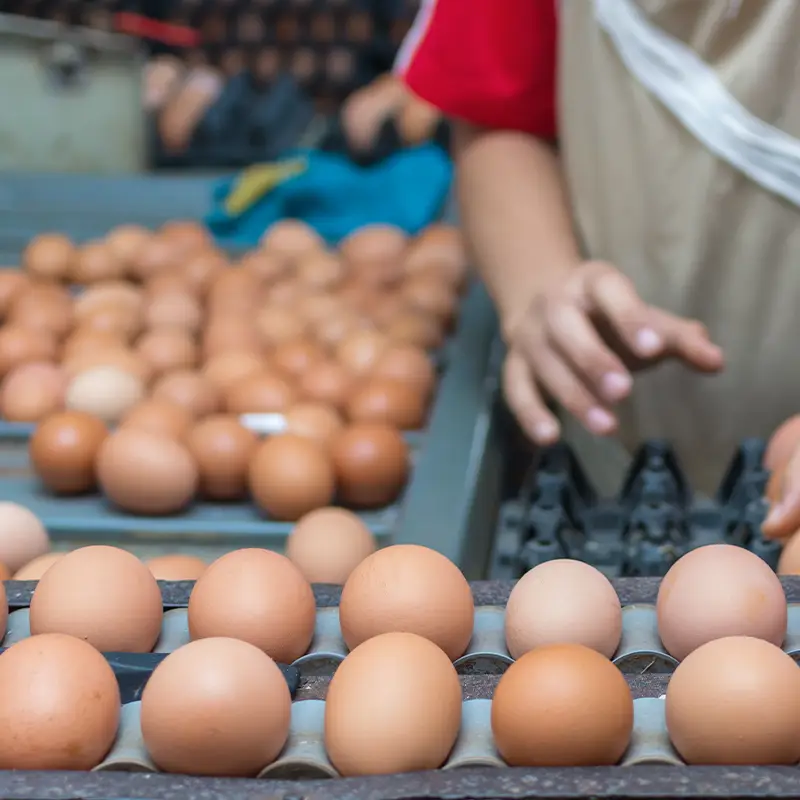
How an advanced inspection system improves quality control
An advanced inspection system improves quality control by enabling objective, consistent, and rapid defect detection, far beyond the capabilities of manual inspection. This type of inspection system uses high-quality cameras and advanced image processing to analyze each egg individually based on a set of predefined criteria. At EN | Elsto Smart Solutions, we integrate these systems directly into your production line, ensuring every egg is scanned without delaying the process. For example, our systems can detect hairline cracks with 99.8% accuracy, which are barely visible to the naked eye, and do so at speeds of tens of thousands of eggs per hour. This results in a drastic reduction in production losses and higher customer satisfaction.
The role of machine vision in egg inspection
Machine vision plays a critical role in egg inspection by enabling automated, contactless quality assessment, which is essential given the delicate nature of eggs. The system captures images of eggs from different positions and under various lighting conditions, after which software analyzes these images for deviations. This includes using UV light to detect bacterial contamination or mold, or near-infrared (NIR) technology to identify internal defects such as blood spots. Our solutions often include multiple cameras per inspection station to view the egg from all angles and detect even the smallest imperfections. This allows you to act proactively and only allow perfect eggs to proceed to the next stage of processing.
Self-learning inspection systems: the future of quality control
Self-learning inspection systems, also known as AI-driven vision systems, are the future of quality control because they continuously improve their detection capabilities through machine learning. This means the system not only recognizes programmed defects but also learns from new deviations it encounters, increasing accuracy over time and reducing the need for human intervention for adjustments. At EN | Elsto Smart Solutions, we implement these technologies to make your egg processing even more intelligent. An example is a system that, after several weeks of training with thousands of egg images (good and abnormal), independently learns to recognize new, subtle deviations that were previously labeled as ‘acceptable’ but still led to complaints. This makes the system extremely adaptive and future-proof. Do you want to know more about the possibilities of automation for your company? Read our blog about industrial automation for manufacturing companies.
Who benefits from camera inspection in egg processing?
Camera inspection in egg processing is beneficial for a wide range of companies within the poultry sector that aim for optimal quality and efficiency. It is particularly suitable for:
This technology is essential for anyone striving for higher product quality, lower operational costs, and a more reliable supply chain.
Elsto Smart Solutions’ approach to error-free egg processing
At EN | Elsto Smart Solutions, we believe that successful camera inspection begins with a thorough analysis of your specific process and challenges. Our approach is always customized, deploying the latest technologies in machine vision and artificial intelligence to design a system that integrates smoothly with your production line. We start with a detailed inventory of the most common defects and the desired detection accuracy, followed by a proof-of-concept phase where we test the feasibility and performance of the technology in your environment. This ensures that the final inspection system not only prevents errors but also delivers a measurable improvement in efficiency and product quality.
This structured approach ensures you invest in a solution that truly works and adds lasting value.
The benefits of an automated inspection system
The benefits of an automated inspection system are diverse and extend beyond merely preventing errors; they optimize the entire production process. The most direct benefit is the unparalleled consistency and accuracy in defect detection, leading to a significantly lower rejection rate and less product loss. We observe an average 30% reduction in complaints among our clients after implementing our systems. Furthermore, automation increases production speed, as eggs can be inspected faster and more efficiently than manually. This means higher throughput and better yield per hour. Another important aspect is improved traceability; each inspected egg can be logged with its quality status, which is crucial for food safety and audits. Learn more about how to automate quality control and optimize processes on our website.
| Benefit | Description | Impact |
|---|---|---|
| Higher accuracy | Detects even tiny defects that the human eye misses. | Fewer product errors, higher product quality. |
| Increased efficiency | Fast and continuous inspection at high production speeds. | Faster throughput, higher output, lower labor costs. |
| Consistent quality | Objective assessment without fatigue or subjectivity. | Uniform product quality, stronger brand image. |
| Cost savings | Less waste, lower labor costs, fewer claims. | Higher profitability, quick ROI. |
| Improved food safety | Early detection of contamination or unsuitable eggs. | Consumer protection, compliance with regulations. |
| Data-driven insights | Collects data on defects for process optimization. | Targeted improvements, prevention of future problems. |
Frequently asked questions about camera inspection in egg processing
What are the main types of defects a camera inspection system can detect?
A camera inspection system can detect a wide range of defects, including external abnormalities such as cracks, breaks, contamination (blood, feces, feathers), and abnormal shapes and sizes. Additionally, advanced systems using specific lighting techniques can also detect internal defects such as blood spots, double yolks, or even early bacterial contamination that are not visible to the naked eye.
How fast can a camera inspection system process eggs?
The processing speed of a camera inspection system is significantly higher than manual inspection. Modern systems can inspect tens of thousands of eggs per hour, ranging from 30,000 to as many as 80,000 eggs per hour, depending on the complexity of the inspection and the line configuration. This ensures efficient flow without bottlenecks.
Is a camera inspection system cost-effective for my business?
A camera inspection system is highly cost-effective in most cases, especially for businesses with medium to large production volumes. The initial investment is often quickly recouped through a combination of lower labor costs, reduced product loss due to rejections, higher product quality, and fewer complaints. We are happy to provide a detailed ROI analysis based on your specific situation.
How reliable are the detection results of these systems?
The detection results of modern camera inspection systems are extremely reliable, often with an accuracy of over 99%. This is due to the use of high-quality sensors, optimized lighting, and advanced algorithms (including AI and machine learning) that objectively and consistently assess each egg without fatigue or subjectivity. Our systems are extensively tested and calibrated.
Conclusion: optimize your egg processing with EN | Elsto Smart Solutions
Camera inspection is no longer a luxury but a necessity for any egg processing company striving for the highest quality standards and operational efficiency. It not only prevents errors that compromise food safety and product quality but also optimizes your entire process through consistency, speed, and cost savings. At EN | Elsto Smart Solutions, we specialize in developing and implementing these advanced vision systems, fully tailored to your unique needs. We have the experience and expertise to transform your egg processing line with smart, reliable, and future-proof solutions. Contact us today to discover how we can help you achieve error-free egg processing.
Related posts